They say that with great literature the words come alive on the page, but what if this actually happened? That the figment of your imagination became reality? This is the premise for Ruby Sparks, a love story with an inventive premise but one that’s portrayal of relationships feels very real. Calvin Weir-Fields (Paul Dano) is a write, whom at the age of 19 wrote a seminal bestselling novel, which he now lives in the shadow of. Struggling with ‘second album’ syndrome, Calvin has writers block and his life is insular, lonely and he finds it hard to meet people, only spending time with his dog Scotty, his brother Harry ( Chris Messina) and his therapist Dr Rosenthal (Elliot Gould). Calvin begins to dream about a girl and, set with an assignment by Dr Rosenthal, to write something ‘bad’ he begins to pen a love story between Ruby (Zoe Kazan), literally the girl of his dreams, and himself. But the lines between reality become blurred and as Calvin spends more and more time in his imaginative world, the hint that Ruby is more than words on a page come to a head when she appears one morning in his kitchen, making breakfast as if it’s the most natural thing in the world. For Ruby, it is, as she believes she is simply his girlfriend and once a frantic, bewildered Calvin realises that he is not completely delusional and that everyone can see Ruby, he begins to relish the chance to have a relationship with the girl he wished for. Initially Calvin decides to no longer write about himself and Ruby and just enjoy the miracle he has created but as Ruby starts to become her own person and develop from the pages that she originated from, Calvin worries she may grow too far away from him and through fear of abandonment, he is faced with the morality of returning to his typewriter to keep his dream girl to himself.
Wednesday, 17 October 2012
Ruby Sparks (directed by Jonathan Dayton and Valerie Faris)
They say that with great literature the words come alive on the page, but what if this actually happened? That the figment of your imagination became reality? This is the premise for Ruby Sparks, a love story with an inventive premise but one that’s portrayal of relationships feels very real. Calvin Weir-Fields (Paul Dano) is a write, whom at the age of 19 wrote a seminal bestselling novel, which he now lives in the shadow of. Struggling with ‘second album’ syndrome, Calvin has writers block and his life is insular, lonely and he finds it hard to meet people, only spending time with his dog Scotty, his brother Harry ( Chris Messina) and his therapist Dr Rosenthal (Elliot Gould). Calvin begins to dream about a girl and, set with an assignment by Dr Rosenthal, to write something ‘bad’ he begins to pen a love story between Ruby (Zoe Kazan), literally the girl of his dreams, and himself. But the lines between reality become blurred and as Calvin spends more and more time in his imaginative world, the hint that Ruby is more than words on a page come to a head when she appears one morning in his kitchen, making breakfast as if it’s the most natural thing in the world. For Ruby, it is, as she believes she is simply his girlfriend and once a frantic, bewildered Calvin realises that he is not completely delusional and that everyone can see Ruby, he begins to relish the chance to have a relationship with the girl he wished for. Initially Calvin decides to no longer write about himself and Ruby and just enjoy the miracle he has created but as Ruby starts to become her own person and develop from the pages that she originated from, Calvin worries she may grow too far away from him and through fear of abandonment, he is faced with the morality of returning to his typewriter to keep his dream girl to himself.
Friday, 7 September 2012
Take this Waltz (directed by Sarah Polley)
May contain plot spoilers
When is a film about romance not so romantic? Perhaps when it is directed by the mistress of malaise Sarah Polley and stars heartbreak heiress Michelle Williams. Following her feature debut Away from Her (2006), which dealt with Alzheimer’s and adultery, Polley’s second film Take this Waltz also examines relationships and the damage that time and tiresomeness with each other can cause. Michelle Williams is Margot, a travel writer, who on a recent assignment meets a handsome young man named Daniel (Luke Kirby); they have a brief flirtation and share a cab ride home together from the airport. This sparkling dalliance is cut short by the omission from Margot that she is married and then is made uncomfortably awkward by the realisation that Daniel is her new neighbour, the ponderous threat that temptation is residing right across the street. Margot returns to husband Lou (Seth Rogen) a lovable, if naively dim, cook book writer but the lingering feeling for something new haunts her and tests whether she will succumb to the desire. Take this Waltz is not an easy film to like, but that is what makes it all the more truthful and raw in its depiction of modern marriage and the unease we feel in life. Polley’s ace in the hole is Michelle Williams, who makes the, on the surface, frustrating Margot (a wife in a safe, comfortable marriage, contemplating adultery) a fully realised human being, a woman with flaws, who cannot feel contentment, something a lot of people cannot admit to themselves. Williams is such an absorbent actress, she can make an audience empathise with her even when she appears selfish and in Margot conveys the sense that she will always be searching for something to fill an unfillable void. This is encompassed in a scene where Margot and Daniel go to an amusement arcade and take a spin on the Scrambler; a ride that takes place in low lights to the sounds of The Bugles video killed the radio star. As they whirl around Margot is lost in a moment of pure bliss, a primitive state of happiness but then the ride stops abruptly, the lights rudely come on and Margot has to face the sombreness of reality again, Williams face capturing the disappointment to perfection.
Sarah Polley’s treatment of the subject matter is handled with great assurance; it does not depict its story with over dramatics, but with the crushing subtlety of internal conflict. There are is no real bad guy in the narrative; we cannot demonise someone who struggles with themselves more than with their relationships. There are however moments were the script falls prey to clunky metaphors, the confession from Margot to Daniel that she uses wheelchairs at airports because she ‘doesn’t like connections’ or the fact that Lou can only write recipes about chicken, his inability to look past the adequate. There is also a deviation in a scene where Daniel describes to Margot what he would do to her sexually, that feels too crude and out of balance with the rest of the film which derails the mood momentarily. But minor missteps aside, Take this Waltz is an honest, touching film with another heartbreaking turn from Williams, it could serve as a Prozac inducing companion piece to Blue Valentine. Credit should also be given to Seth Rogen, who dials down his usual goofiness, proving particularly effective in a scene where he realises his wife’s head has been turned, the camera remains on his face, jump cutting between the many reactions and emotions that come from heartache. Polley’s film leaves us with more questions than it answers, as Margot finds out that perhaps the grass is, literally not always greener. As one female comments in the film ‘new gets old’ and so does the inevitability that you cannot outrun your own malaise. As Margot takes a ride on the Scrambler, this time alone at the end of the film, an air of ambiguity lies, will she ever be content or will she be capable to overcome her fear of ‘connections’?
When is a film about romance not so romantic? Perhaps when it is directed by the mistress of malaise Sarah Polley and stars heartbreak heiress Michelle Williams. Following her feature debut Away from Her (2006), which dealt with Alzheimer’s and adultery, Polley’s second film Take this Waltz also examines relationships and the damage that time and tiresomeness with each other can cause. Michelle Williams is Margot, a travel writer, who on a recent assignment meets a handsome young man named Daniel (Luke Kirby); they have a brief flirtation and share a cab ride home together from the airport. This sparkling dalliance is cut short by the omission from Margot that she is married and then is made uncomfortably awkward by the realisation that Daniel is her new neighbour, the ponderous threat that temptation is residing right across the street. Margot returns to husband Lou (Seth Rogen) a lovable, if naively dim, cook book writer but the lingering feeling for something new haunts her and tests whether she will succumb to the desire. Take this Waltz is not an easy film to like, but that is what makes it all the more truthful and raw in its depiction of modern marriage and the unease we feel in life. Polley’s ace in the hole is Michelle Williams, who makes the, on the surface, frustrating Margot (a wife in a safe, comfortable marriage, contemplating adultery) a fully realised human being, a woman with flaws, who cannot feel contentment, something a lot of people cannot admit to themselves. Williams is such an absorbent actress, she can make an audience empathise with her even when she appears selfish and in Margot conveys the sense that she will always be searching for something to fill an unfillable void. This is encompassed in a scene where Margot and Daniel go to an amusement arcade and take a spin on the Scrambler; a ride that takes place in low lights to the sounds of The Bugles video killed the radio star. As they whirl around Margot is lost in a moment of pure bliss, a primitive state of happiness but then the ride stops abruptly, the lights rudely come on and Margot has to face the sombreness of reality again, Williams face capturing the disappointment to perfection.
Sarah Polley’s treatment of the subject matter is handled with great assurance; it does not depict its story with over dramatics, but with the crushing subtlety of internal conflict. There are is no real bad guy in the narrative; we cannot demonise someone who struggles with themselves more than with their relationships. There are however moments were the script falls prey to clunky metaphors, the confession from Margot to Daniel that she uses wheelchairs at airports because she ‘doesn’t like connections’ or the fact that Lou can only write recipes about chicken, his inability to look past the adequate. There is also a deviation in a scene where Daniel describes to Margot what he would do to her sexually, that feels too crude and out of balance with the rest of the film which derails the mood momentarily. But minor missteps aside, Take this Waltz is an honest, touching film with another heartbreaking turn from Williams, it could serve as a Prozac inducing companion piece to Blue Valentine. Credit should also be given to Seth Rogen, who dials down his usual goofiness, proving particularly effective in a scene where he realises his wife’s head has been turned, the camera remains on his face, jump cutting between the many reactions and emotions that come from heartache. Polley’s film leaves us with more questions than it answers, as Margot finds out that perhaps the grass is, literally not always greener. As one female comments in the film ‘new gets old’ and so does the inevitability that you cannot outrun your own malaise. As Margot takes a ride on the Scrambler, this time alone at the end of the film, an air of ambiguity lies, will she ever be content or will she be capable to overcome her fear of ‘connections’?
Monday, 23 July 2012
Killer Joe (directed by William Friedkin)
Kentucky Fried Movie
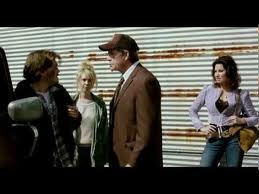
“I don’t want people to enjoy this film” said William Friedkin of his latest cinematic work, and whilst the director has always been known to court the press and in turn the censorship threshold with his malevolence, he may just have a point with Killer Joe. The story of a white trash trailer park family of no good cheaters and liars is a Southern fried noir with a literal nasty taste to it, however it is also bleakly and darkly funny view of inept misfits in a hopeless situation. You may not like yourself for sniggering but sniggering you just may do. Killer Joe tells the tale of the Smith family, a bunch of lowlife losers, living off junk food and beer and years of possible scams to make more money. Ansel the father, (Thomas Hayden Church) is a worthless, yet harmless lay about who paves the way for son Chris (Emile Hirsch) to act like the patriarch of the family, albeit in a reckless and rough fashion. Stepmother Sharla (Gina Gershon) is a brazen pizza waitress with a side order of adultery, leaving the youngest of the clan, the wide eyed innocent Dottie (a mesmerising, childlike Juno Temple) as the only beacon of light in this dank, dirty set up. Yet the inevitable sense of desolation tells you it is only a matter of time before she too is corrupted.
When a desperate Chris returns to the family trailer, in dire need of cash to stop a hit on him due to a bungled deal with the local drug boss, he comes up with a double indemnity style plan to solve his wretched situation. His seedy saviour is Killer Joe (a delightfully dark Matthew McConaughey), a police detective with an unorthodox sideline in contract killing, whom Chris plans to hire to murder the family’s biological mother who all but abandoned her kids, and so claim a $50,000 life insurance policy that is due to befall to Dottie. Enlisting hapless father Ansel into the mix, who latches onto the unfamiliar scent of a big payday, their plot is hit by the significant snag that they are unable to pay Joe upfront for the job, his fee due to come from the insurance pay out. But Joe comes up with a sinister lifeline, having taken a shine to the virginal Dottie; he proposes to use her as a ‘retainer’, to do with what he pleases, until the insurance comes through.
Based on the play by Tracey Letts, Killer Joe retains much of the claustrophobic stage setting by placing most of the scenes within the Smiths cramped home and though the film does leave the confines of the trailer park for a few exterior scenes, you continually get the feeling that there is no escape, that all roads lead back to despondent gloom. There will be no happy endings and predictably no one gets away clean as the plot unravels before the family’s eyes. Friedkin takes this fairly simplistic premise that has been used in various incarnations in previous noirs, and turns it into a startling uncomfortable, tar black humour filled thriller. The film borrows sombre shades from directors David Lynch with pseudo sexual maniac Joe and The Coens in its redneck goofiness and double crossing deals. Cinematographer Caleb Deschanel creates a magnetic backdrop of the Texan landscape which is barrow and rundown, the odd twinge of guitar creeps into the soundtrack to add to the creepy brooding tension. All the cast excel, they become so ingrained in their personas, that it is impossible to imagine anyone else in their roles, particularly Juno Temple as Dottie, her girlish mannerisms and doll eyed cherubic nature is all the more haunting when she is seduced by Joe in a particularly disconcerting scene. The casting revelation comes from Matthew McConaughey however as the titular Joe, sticking two thumbs up to the romcom mush he has been treading water in for many years. His Southern drawl used to hypnotic effect, a snake like presence that is repulsive in his actions yet impossible to take your eyes off. And yes he does take his top off but all thoughts of buff sex symbol McConaughey will be forgotten when he is taking advantage of an underage girl and using sexual violence to get revenge.
Much has been made of ‘that chicken scene’ and there are many explicit scenes not for the easily offended and faint hearted, the film taking an accelerated turn as it sprints to the finish line, but it does so with such sly wit and mischief that you cannot help but be drawn into the madness. Go with Friedkin’s messed up ride and you will ‘enjoy’ the anarchy. Sure, you will from now on shudder each time you pass a KFC, but is that an entirely bad thing?
“I don’t want people to enjoy this film” said William Friedkin of his latest cinematic work, and whilst the director has always been known to court the press and in turn the censorship threshold with his malevolence, he may just have a point with Killer Joe. The story of a white trash trailer park family of no good cheaters and liars is a Southern fried noir with a literal nasty taste to it, however it is also bleakly and darkly funny view of inept misfits in a hopeless situation. You may not like yourself for sniggering but sniggering you just may do. Killer Joe tells the tale of the Smith family, a bunch of lowlife losers, living off junk food and beer and years of possible scams to make more money. Ansel the father, (Thomas Hayden Church) is a worthless, yet harmless lay about who paves the way for son Chris (Emile Hirsch) to act like the patriarch of the family, albeit in a reckless and rough fashion. Stepmother Sharla (Gina Gershon) is a brazen pizza waitress with a side order of adultery, leaving the youngest of the clan, the wide eyed innocent Dottie (a mesmerising, childlike Juno Temple) as the only beacon of light in this dank, dirty set up. Yet the inevitable sense of desolation tells you it is only a matter of time before she too is corrupted.
When a desperate Chris returns to the family trailer, in dire need of cash to stop a hit on him due to a bungled deal with the local drug boss, he comes up with a double indemnity style plan to solve his wretched situation. His seedy saviour is Killer Joe (a delightfully dark Matthew McConaughey), a police detective with an unorthodox sideline in contract killing, whom Chris plans to hire to murder the family’s biological mother who all but abandoned her kids, and so claim a $50,000 life insurance policy that is due to befall to Dottie. Enlisting hapless father Ansel into the mix, who latches onto the unfamiliar scent of a big payday, their plot is hit by the significant snag that they are unable to pay Joe upfront for the job, his fee due to come from the insurance pay out. But Joe comes up with a sinister lifeline, having taken a shine to the virginal Dottie; he proposes to use her as a ‘retainer’, to do with what he pleases, until the insurance comes through.
Based on the play by Tracey Letts, Killer Joe retains much of the claustrophobic stage setting by placing most of the scenes within the Smiths cramped home and though the film does leave the confines of the trailer park for a few exterior scenes, you continually get the feeling that there is no escape, that all roads lead back to despondent gloom. There will be no happy endings and predictably no one gets away clean as the plot unravels before the family’s eyes. Friedkin takes this fairly simplistic premise that has been used in various incarnations in previous noirs, and turns it into a startling uncomfortable, tar black humour filled thriller. The film borrows sombre shades from directors David Lynch with pseudo sexual maniac Joe and The Coens in its redneck goofiness and double crossing deals. Cinematographer Caleb Deschanel creates a magnetic backdrop of the Texan landscape which is barrow and rundown, the odd twinge of guitar creeps into the soundtrack to add to the creepy brooding tension. All the cast excel, they become so ingrained in their personas, that it is impossible to imagine anyone else in their roles, particularly Juno Temple as Dottie, her girlish mannerisms and doll eyed cherubic nature is all the more haunting when she is seduced by Joe in a particularly disconcerting scene. The casting revelation comes from Matthew McConaughey however as the titular Joe, sticking two thumbs up to the romcom mush he has been treading water in for many years. His Southern drawl used to hypnotic effect, a snake like presence that is repulsive in his actions yet impossible to take your eyes off. And yes he does take his top off but all thoughts of buff sex symbol McConaughey will be forgotten when he is taking advantage of an underage girl and using sexual violence to get revenge.
Much has been made of ‘that chicken scene’ and there are many explicit scenes not for the easily offended and faint hearted, the film taking an accelerated turn as it sprints to the finish line, but it does so with such sly wit and mischief that you cannot help but be drawn into the madness. Go with Friedkin’s messed up ride and you will ‘enjoy’ the anarchy. Sure, you will from now on shudder each time you pass a KFC, but is that an entirely bad thing?
Wednesday, 18 July 2012
My Favourite Movie of the Year....so far
Moonrise Kingdom (directed by Wes Anderson)
All reviewers of a new Wes Anderson film have to address, the Wes-ness of a Wes Anderson film. He is a director who brings a unique visual style to each of his features, one that the term Auteur was meant for, his work brimming with distinction. His is also one that the term Marmite was meant for, you either embrace the fantastical world he creates or recoil at the kookiness of it all, longing for the days that when Bruce Willis played a cop in a film, it was violence in a white vest and not as a buttoned down officer of a remote island. This reviewer falls into the former category, revelling in the intricate details and oddball characters that consume his cinematic microcosm, whilst also being astounded (and a smidge jealous) that he manages to not only get away with very quirky concepts, but also making them feel somehow natural. Few filmmakers can pull off this fine line act but Anderson does so in spades… the clever jerk.
Though whilst his last film Fantastic Mr Fox (2009) was an animated match made in heaven, Wes’s narrative proclivities suited beautifully to the stop motion technique, his previous effort The Darjeeling Limited (2007) was a slight misstep, verging towards indulgence without the real emotion that he usually balances so well. However with Moonrise Kingdom, Anderson is back to his best, in a film that threatens to be the best of his career.
Moonrise, is set on an idyllic New England island in the summer of 1965, a haven for eccentric characters and blossoming love. Amongst the island is a ‘khaki scout’ summer camp lead by Edward Norton’s endearing scout master Ward and where one of its troop, Sam Shakusky, flies the coup (in an entertaining homage to a certain prison film) to run away with his beloved pen pal Suzy Bishop. Sam and Suzy are troubled children, two idiosyncratic 12 year old misfits, each with their own bag of neurosis at such a young age. When Sam meets Suzy the previous year at a church performance of Noye’s Fludde by Benjamin Britten, the two remain pen friends and make a pact to run away together the following year on the island. They head to a secluded cove on the edge of the island but in hot pursuit are his scout master Ward and the rest of the khaki scouts, the local police Captain Sharp (Bruce Willis) and Suzy’s parents Walt (Bill Murray) and Laura (Frances McDormand).
What follows is a kaleidoscope of scenes, dreamily enveloped
in tawny and sage colours with a hint of 60s colour pop, etched with oddities and
wistful recollections of the bittersweet terrain that childhood crosses. The
two young star crossed lovers Suzy and Sam (played endearingly without any hint
of precocious annoyance by newcomers Kara Hayward and Jared Gilman) display the
naivety of adolescent first love, the zest for adventure and the freshness of
youth, yet they have a wisdom beyond their years, affected by their
surroundings and upbringing, Sam being an orphan, Suzy labelled as a girl with
‘issues’. The two unknown child actors are complimented, rather than overshadowed by the rest of
Anderson has pulled off one almighty achievement in creating such a dotty, playful movie but one with an emotional chord that slowly creeps up on you. By the time you leave the cinema, the feeling of enjoyable glee is tinged with the sudden realisation that childhood is gone and you ache and mourn for that period in your life, when you were a kid and could take on the world, the fearlessness and the fervent spirit of youth. Moonrise Kingdom is a film made with the heart of a 12 year old, in fact it seems we are watching a film made by Wes Anderson’s adolescent self (albeit one with his usual wit and flair). The feeling of innocence and love is overwhelmingly infectious and the portrayal of a moment in life that was pure, reminds us that whilst that time has passed, it lives on in our memories, like the titular haunt of Moonrise Kingdom, (and in turn, the film itself) it is a place that will live on in a nostalgic beautiful sublime haze.
Tuesday, 10 July 2012
Grease is the Word
Over the past few years Cinema Sing-a-longs have become something of a big hit with audiences, where people can go to watch their favourite film with bells on. Those bells being karaoke lyric tracks on the screen so everyone can sing to their favourite songs, while added visuals pop up to prompt the audience. There is also the inclusion, in some cases, of a goodie bag with various items that can be used at certain parts of the film and the emphasis on encouraging the viewers to come in fancy dress as their favourite character. The most popular of those cinematic hybrids have been Mamma Mia (I literally cannot think of a worse punishment to bestow on someone) and The Sound of Music (am I the only one that feels that a theatre full of pretend nuns is a scary prospect?).
My first experience of this mad mad world came last weekend when I went to a Sing-a-long with Grease night at the Empire theatre in Liverpool with two fellow pink ladies and one hopelessly emotive Sandy. I have quite a lot of affection for the movie, though no where near as much as many of my fellow theatregoers, and our own Sandy wanted to play out a lifelong dream to be Ms Dee so I decided to give it a go. We had our ‘Summer Lovin’ Sandy, as perky and naive as they come. We had our Rizzo, who was definitely the most, ahem, experienced of us all. We had our Frenchie, the sweetest and most loyal of the bunch. Then there was me, as Marty, who yes is somewhat of a two bit part, not the most memorable of the pink ladies but she did have a few choice lines, a natty perchance for neck scarf’s and was less likely to be imitated on the night, due to her lower ranking in the pink lady food chain.
Our compeer for the evening was again a not so in his prime Danny, who had hastily thrown on a leather jacket and quiff wig to take to the stage, though he did receive a rapturous applause from the baying crowd. Danny then did his best Butlins entertainer routine as his went through the ‘rules’ for the evening, how to perform the hand jive and the contents of the goodie bag. So we had to swoon whenever Danny came on screen (the real one not the later life version), we had to boo when bad guy crater face came into frame, we had to make catty noises for Rizzo and so on and so forth. Our little bag of tricks contained props to help us along our merry journey, including hankies for the weepy Sandy solo ‘Hopelessly Devoted To You’, a chequered flag for the drag race where T Bird Danny takes on crater face (my personal favourite item of the night) and a bag of pretzels, supplied by the sponsors of the event, who were randomly a pretzel company. Then came the slightly annoying part- the fancy dress competition. Butlins Danny welcomed all to come and join in the competition to win a dubious selection of prizes, and an array of colourful characters took to the stage, including our very own ‘Summer Lovin’ Sandy. For whilst there was a range of outfits from the inspired (Eugene!!) to the ridiculous (since when did the pink ladies dress as school girls with face paint and knee high socks?), the annoying part was that no matter how faithful you were to the original costumes, you were never going to win against a five year old dressed in a Ra-Ra skirt. And this leads me to my biggest grumble of the event- children, don’t get me wrong, I am not one to deprive a child of a cinematic trip, but this perhaps should have been part of a matinee performance, rather than letting an infant stay up on a Friday night in a room full of women being encouraged to thrust their hips provocatively at the screen. The tone of the evening seemed at odds, one minute we were maintaining a family friendly atmosphere by editing the word cream from the lyrics to ‘Grease Lightning’ and the next we are shaking our pelvis’ faster than Elvis at Vegas.
But inappropriateness aside, I threw myself into the spirit of the night and while I tried to watch my language, I soon forgot about the children, two of whom I was probably blocking the view of the screen anyway, due to proximity behind me. As someone who usually can't stand it if people chat during a film, it was an interesting, and welcome change to actually be encouraged to whoop and holler at the screen, which our party did with gusto. Things got rather messy at times, when a crowded auditorium are all trying to dance in the aisles at the same time, things are going to go awry, but it was a truly fun, immersive experience and a new way to watch a beloved favourite film. It was also great to see our Sandy enjoying her favourite movie, once she got past being called soppy Sandy, much to her chagrin. When somebody gets to knock something off their bucket list, it is an infectious occurrence.
And so we bopped and jived through the film and the night, ending in a crescendo of party poppers bursting as Danny and Sandy fly (?) off into the sunset.
We left the theatre, many worse for wear ladies and duff Dannys spilling out into the streets of Liverpool and our time at Rydell was over. As we drove off into the sunset, we however didn’t take off into the air, we clutched our bags of pretzels with a smile on our faces from the evening’s frivolities.
Reflecting on my first time at a Sing-a-long event, I hung up my pink lady jacket and while I was hoarse of throat, I was filled with memories of a weird but wonderful time.
Now if only they can do a Bugsy Malone one……
Friday, 20 April 2012
Sell out of the Month April Edition ( by guest blogger Simon Wilkinson)
Jeremy Renner

Simon Says:
Please don’t get me wrong people. I love Jeremy Renner; he’s a brilliant, gifted and charismatic actor. Hawkeye? No Jeremy, not again! Fair enough you play it with style but twice? Along side an Aussie Thor? Where are you going to draw the line with Marvel?
Oh, and lest we forget you are “taking over” from Tom Cruise in the Mission Implausible franchise and you’re playing a similar role in the upcoming Bourne Legacy. You’ve got to make your money when you can in the Hollywood game but you can only put your fingers in so many pies before one gets burned.
How long is it going to be before they cross over the Mission Improbable and Bourne universes and you end up fighting yourself in a Star Trek style finale?
Jump ship Jezza, get outta there and don’t do any more sequels. Although we know it’s where the money is.

I say:
Jeremy, Jeremy my very own Jeremy, I have felt like you were my own charming indie discovery since watching you in little seen gem Twelve and Holding (check it out, it really is a treat). But Hawkeye did always seem like a strange choice for you and the thought of you continuing the Bourne movies when they seemed tied up and done is a bit disappointing but let’s review the evidence for the defence.
Renner has been somewhat overlooked in recent years, when he should have been given more recognition, his intense turn in the criminally underrated The Town has all been but ignored and whilst his blistering performance in The Hurt Locker garnered plaudits, it was Bigelow that took all the glory (though this was indeed deserved as well). And what actor, deep down, wouldn’t want the chance to live out a childhood guilty pleasure fantasy of starring as a superhero in a big action film?
We cannot also assume that Renner is taking over the Mission Impossible franchise, yes it’s been hinted at but this has not been confirmed yet. But even if he does, should he not enjoy a slice of the action pie and make a bit of money since he is still not a household name and is pushing 40, coming late to the game by Hollywood’s standards.
Verdict: Not quite a sell out at this point in time I’m but keeping my (hawk) eye on him.
Saturday, 7 April 2012
What I watched last night
Film 4
Gentlemen Broncos (directed by Jared Hess)
When you watch a film by Jared Hess, you either embrace the oddball universe he creates or you don’t, if you are the type of person who avoids a signpost marked ‘Quirky Town’, then its best to keep on driving. Like fellow director Wes Anderson he surrounds his films with kooky characters and whimsical plot devices, though his world is less bourgeoisie and a little more lovably yokel. Hess’ debut film Napoleon Dynamite was a cult phenomenon, its central character became a left field icon, it was an eccentric yet charming creation with its own unique humour.
Hess’ third feature film Gentlemen Broncos, which premiered on Film 4 last night, did not follow in Napoleons footsteps, it was intended for release in October 2009 but due to poor reviews, it limped straight onto DVD and quietly disappeared into the rental wilderness.
The film follows the malaise adventures of introverted teenager Benjamin Purvis (Michael Angarano) who writes science fiction novels and lives with his mother (Jennifer Coolidge on sweetly dippy duties) who designs odd clothes and makes hard popcorn balls. Benjamin attends a writing camp for aspiring fantasy novelists, where his idol Ronald Chevalier is lecturing and who announces a competition for the writers where their story will be published nationally. Chevalier (Jermaine Clement sounding like a egotistical Michael York) is a narcissistic writer who has run out of ideas and is on the verge of being dropped by his publishing company. When Benjamin submits his fantasy novel Yeast Lords, centred on a hero called Bronco, Chevalier steals his idea, changing the novel slightly by turning the central character into a transsexual, and the book becomes a hit. When Benjamin discovers that his idea has been plagiarised, he must prove that Yeast Lords was his original story whilst also battling the perils of adaptation as he had previously sold the rights to his book to a couple of amateur filmmakers.

Hess’ third feature film Gentlemen Broncos, which premiered on Film 4 last night, did not follow in Napoleons footsteps, it was intended for release in October 2009 but due to poor reviews, it limped straight onto DVD and quietly disappeared into the rental wilderness.
The film follows the malaise adventures of introverted teenager Benjamin Purvis (Michael Angarano) who writes science fiction novels and lives with his mother (Jennifer Coolidge on sweetly dippy duties) who designs odd clothes and makes hard popcorn balls. Benjamin attends a writing camp for aspiring fantasy novelists, where his idol Ronald Chevalier is lecturing and who announces a competition for the writers where their story will be published nationally. Chevalier (Jermaine Clement sounding like a egotistical Michael York) is a narcissistic writer who has run out of ideas and is on the verge of being dropped by his publishing company. When Benjamin submits his fantasy novel Yeast Lords, centred on a hero called Bronco, Chevalier steals his idea, changing the novel slightly by turning the central character into a transsexual, and the book becomes a hit. When Benjamin discovers that his idea has been plagiarised, he must prove that Yeast Lords was his original story whilst also battling the perils of adaptation as he had previously sold the rights to his book to a couple of amateur filmmakers.

Whilst the film is confused, often going too far into the realms of nonsense, there is some grin-inducing appealing moments, sci fi geeks will enjoy the pastiches on the genre and the literature satire provided by the disillusioned Chevalier. It should also be applauded that in a time of bland studio movies, something so gleefully original ever got the green light and saw the light of day, though confidence in the film was not in abundance and its poor reception was inevitable. On first viewing, Gentlemen Broncos does not have the enduring quality of Napoleon Dynamite but is the type of film that could, and should find its natural home on DVD, a future cult hit waiting to happen, one for Conchord fans, Sam Rockwell lovers and those who like to take a walk on the weird side. Happily I am all three of those things.
Subscribe to:
Posts (Atom)